Déclaration
The Execution of Akram Buraale Ahmed and the Irreversible Failure of Somaliland's Justice System
A profound miscarriage of justice, the extinguishing of human life and the urgent demand for accountability.
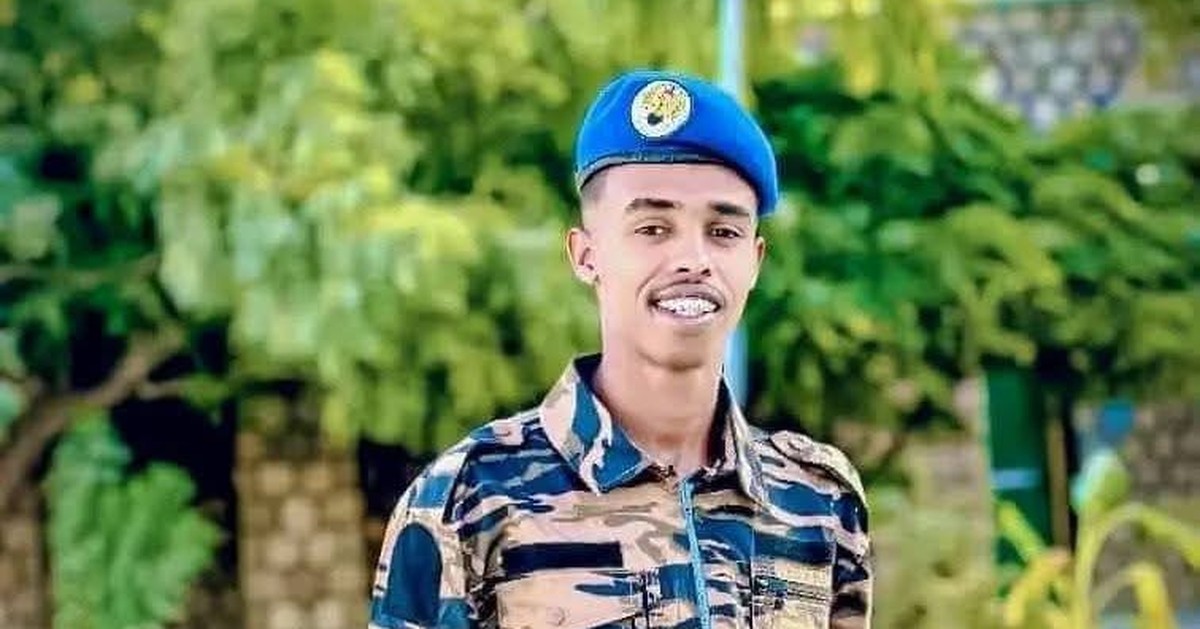
The Somaliland Human Rights Monitoring Group (SHRMG) expresses its profound condemnation of the execution of Akram Buraale Ahmed, one of nine individuals executed by Somaliland authorities at Mandera on 11 November 2026.
The execution raises grave questions concerning the right to life, the administration of capital punishment, the independence and transparency of judicial proceedings, the protection of defendants’ rights and the Somaliland government’s compliance with internationally recognised human rights standards.
SHRMG is particularly disturbed by the circumstances surrounding Akram’s case. Information received by the organisation indicates that he was involved in a fatal incident in Erigavo in 2024 while participating in a government-directed security operation. He reportedly caused the accidental death of an individual whom he had not previously known. He was subsequently convicted and sentenced to death, before being executed by firing squad more than two years later.
Akram’s family was reportedly not informed of his execution beforehand. If confirmed, this would represent an additional and deeply troubling failure of transparency towards his immediate family.
The authorities have now extinguished a human life through an irreversible punishment. Yet fundamental questions about the circumstances of the original incident, the nature of Akram’s criminal responsibility, the judicial proceedings, the availability of appeals and the family’s involvement remain unanswered.
An execution cannot become proof of justice simply because a government has authorised it. Nor does the invocation of religious law exempt public authorities from their obligations under international human rights standards.
SHRMG considers this case emblematic of the dangers of a criminal justice system in which the state exercises the ultimate power over human life without providing the public with sufficient information to independently examine the legality, fairness and proportionality of its decisions.
1. THE EXECUTION OF NINE INDIVIDUALS AND THE STATE’S IRREVERSIBLE EXERCISE OF POWER
On 11 November 2026, Somaliland authorities executed nine individuals by firing squad at Mandera, in the Sahil region, following presidential authorisation of their death sentences.
Contemporary media reports identified Akram Buraale Ahmed among those executed. Reporting indicates that most of the nine had served in Somaliland’s security institutions, while some cases had reportedly been adjudicated by military courts.
The authorities have not made the complete judgments, individual case records, appeal histories or detailed circumstances of all nine cases publicly accessible in the reporting examined by SHRMG.
SHRMG is particularly concerned by the reported execution of nine people on the same day without adequate public disclosure of the individual judicial proceedings.
Each individual was entitled to an independent assessment of his case, access to competent legal representation, the opportunity to appeal, consideration of mitigating circumstances and access to any applicable pardon or commutation procedures.
The execution of nine individuals cannot be justified merely by announcing that courts previously convicted them. A death sentence is not self-validating. Its legality depends on the integrity of the proceedings, the evidence, the applicable law and the fulfilment of every mandatory safeguard.
Where the punishment is irreversible, the duty to establish that these safeguards have been observed is especially exacting.
2. AKRAM BURAALE AHMED: THE CIRCUMSTANCES THAT DEMAND INVESTIGATION
Information received by SHRMG indicates that Akram was participating in a government-directed security operation in Erigavo in 2024 when an individual was accidentally shot and killed.
Akram reportedly had no previous personal relationship with the deceased. The incident occurred in the context of a security operation in which he was acting under government instructions.
SHRMG does not seek to diminish the loss of the original victim or the suffering of that person’s family. Every death deserves recognition, a credible investigation and an effective remedy.
However, the existence of a fatal incident does not eliminate the obligation to distinguish between intentional killing, accidental death, negligence, individual criminal responsibility and institutional responsibility.
These distinctions are fundamental to criminal justice.
If the original death was accidental rather than intentional, and if that was the factual basis on which Akram was convicted, the imposition of capital punishment raises a particularly serious question under Article 6 of the International Covenant on Civil and Political Rights.
The United Nations Human Rights Committee, in General Comment No. 36, paragraph 35, has clarified that the expression ‘most serious crimes’ under Article 6 is restricted to crimes of extreme gravity involving intentional killing. Crimes that do not directly and intentionally result in death cannot qualify for capital punishment under that standard.
Accordingly, SHRMG calls for the immediate disclosure of the original criminal judgment, the prosecution’s evidence, the findings concerning intent, the applicable offence and the reasons the court considered the death penalty legally permissible.
The authorities must explain whether Akram was convicted of intentional murder, an offence involving negligence, an accidental killing or another category of homicide.
The difference is not semantic. It may determine whether the execution complied with the international restrictions governing capital punishment.
3. THE GOVERNMENT’S OWN DOCUMENTS: AN OFFICIAL RECORD THAT CANNOT BE IGNORED
SHRMG possesses three official communications issued by the Somaliland Police Force and the Ministry of Interior and Security concerning the death of 18-year-old Ayaanle Maxamuud Cumar during police operations in Erigavo in May 2024.
These documents are significant because they provide the government’s own account of a fatal incident during the same period and its subsequent consideration of compensation.
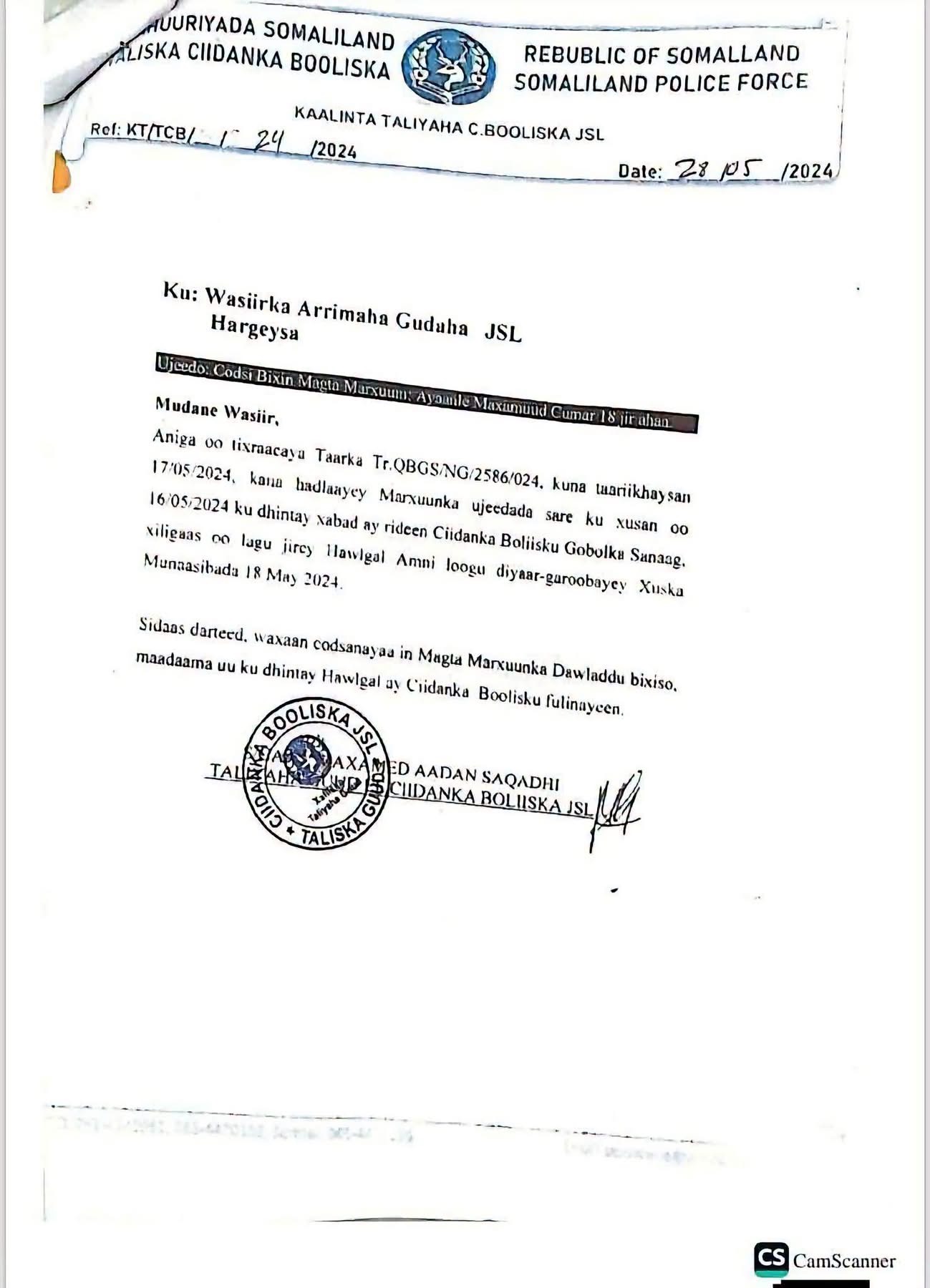
Document I: Somaliland Police Force, 28 May 2024
The first document is a police communication dated 28 May 2024, bearing reference KT/TCB/3/3-24/2024.
 Ouvrir l’image en grand dans un nouvel onglet.
Addressed to the Minister of Interior, the letter concerns a request for compensation for the late Ayaanle Maxamuud Cumar, aged 18.
The police correspondence records that Ayaanle was shot and killed on 16 May 2024 by Sanaag regional police during a security operation undertaken in preparation for the 18 May celebrations.
The police command requested that the government pay compensation to the deceased’s family because the fatal incident occurred during an operation conducted by the police.
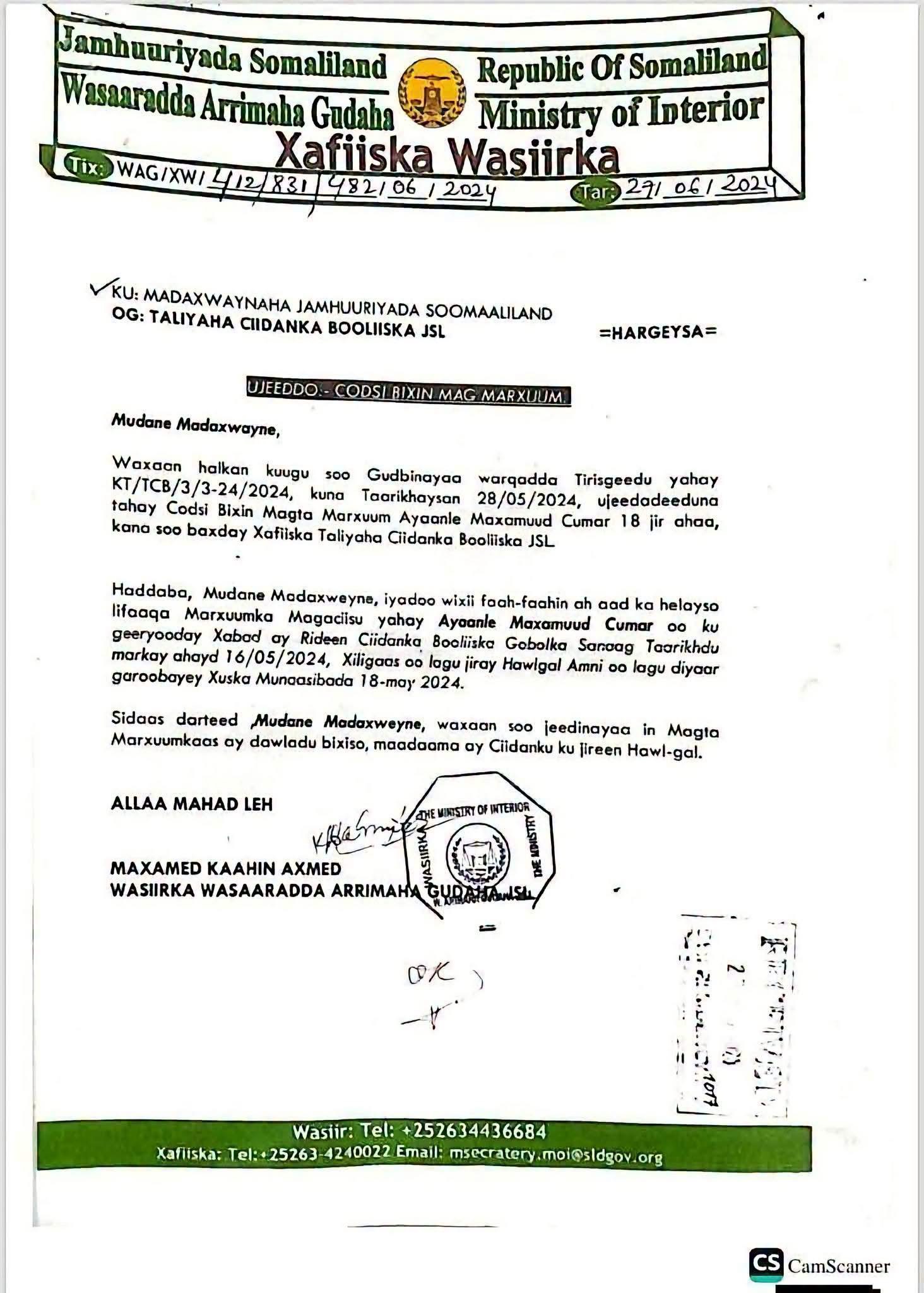
Document II: Ministry of Interior, 29 June 2024
The second document, dated 29 June 2024 and bearing reference WAG/XW/412/831/482/06/2024, was issued by the Ministry of Interior under former Interior Minister Mohamed Kaahin Ahmed.
 Ouvrir l’image en grand dans un nouvel onglet.
The Minister forwarded the police command’s compensation request to the President and recommended that the government pay the compensation.
The correspondence expressly links the government’s responsibility to the fact that the death occurred during an operation conducted by government security forces.
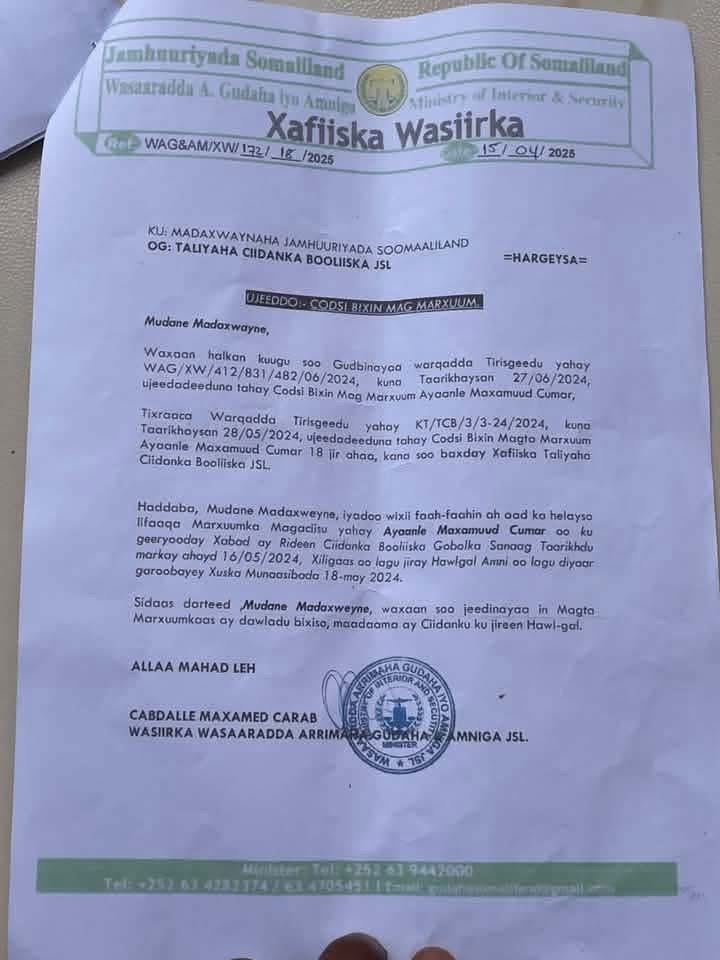
Document III: Ministry of Interior and Security, 15 April 2025
The third document, dated 15 April 2025 and bearing reference WAG/AM/XW/121/18/2025, was issued by the Ministry of Interior and Security under Minister Cabdalle Maxamed Carab.
 Ouvrir l’image en grand dans un nouvel onglet.
Addressed to the President, the letter again refers to the compensation request concerning Ayaanle Maxamuud Cumar and reiterates the circumstances recorded in the earlier police and ministerial communications.
It records the earlier correspondence and again recommends that the government pay compensation to the deceased’s family.
Why these documents matter
These three documents establish an important official documentary record:
- The Somaliland Police Force acknowledged a fatal shooting during a government security operation.
- The police command formally requested compensation for the deceased’s family.
- The former Interior Minister forwarded the request to the President.
- The Ministry of Interior and Security subsequently reiterated the recommendation.
- The government was therefore formally placed on notice of the death and the request for compensation.
SHRMG does not claim that the documents establish that compensation was actually paid.
Nor do the documents, by themselves, establish that Akram fired the fatal shot. Indeed, they attribute the fatal shooting of Ayaanle to Sanaag regional police. The relationship between that official account and the information concerning Akram’s involvement must be independently established.
This discrepancy makes disclosure of the original police investigation and criminal proceedings indispensable.
The authorities must explain precisely how Ayaanle died, who fired the fatal shot, what role Akram was found to have played, and how the subsequent criminal proceedings reconciled these facts.
The government cannot reasonably maintain an incomplete official record while asking the public to accept an irreversible punishment as the final expression of justice.
Most importantly, if the government considered compensation appropriate because a death occurred during an official security operation, it must explain how it assessed the state’s responsibility for the operation itself, its orders, its supervision and its consequences.
4. THE INTERNATIONAL LEGAL FRAMEWORK: THE RIGHT TO LIFE AND THE LIMITS OF CAPITAL PUNISHMENT
SHRMG recalls that the right to life is the foundation upon which all other human rights depend.
The following international instruments and standards are directly relevant to the assessment of Akram’s execution and the broader use of capital punishment.
A. International Covenant on Civil and Political Rights (ICCPR)
Somalia acceded to the ICCPR on 24 January 1990.
The Covenant is therefore central to the assessment of human rights obligations applicable to Somalia, including questions of jurisdiction and the conduct of authorities exercising effective control over territory.
Article 6 – Right to life
Article 6(1) protects the inherent right to life and prohibits arbitrary deprivation of life.
Article 6(2) restricts the death penalty, in states that retain it, to the most serious crimes and requires a final judgment by a competent court.
Article 6(4) guarantees every person sentenced to death the right to seek pardon or commutation.
Article 6(6) makes clear that the Covenant must not be used to delay or prevent the abolition of capital punishment.
Article 7 – Prohibition of torture and cruel, inhuman or degrading treatment or punishment
The manner in which capital punishment is imposed and carried out must be assessed against the prohibition of torture and cruel, inhuman or degrading treatment or punishment.
Article 14 – Fair trial guarantees
Every accused person is entitled to equality before the courts and a fair and public hearing before a competent, independent and impartial tribunal established by law.
The protections include adequate time and facilities to prepare a defence, legal assistance, the examination of witnesses and the right to appeal a conviction and sentence to a higher tribunal.
Article 2(3) – Effective remedies
The state must ensure an effective remedy where protected rights have been violated, including where violations are committed by individuals acting in an official capacity.
B. UN Human Rights Committee General Comment No. 36 (2018/2019)
General Comment No. 36, concerning Article 6 of the ICCPR, provides authoritative interpretation of the right to life.
Paragraph 35 is particularly important in Akram’s case.
It states that the most serious crimes must be understood restrictively and must involve intentional killing.
If Akram’s original offence was genuinely accidental, rather than an intentional killing, SHRMG considers that his execution raises a fundamental question of compatibility with Article 6.
Paragraph 37 further requires courts to consider the personal circumstances of the accused and the particular circumstances of the offence, including mitigating circumstances.
Paragraph 41 addresses the strict requirements for fair-trial guarantees in capital cases.
C. Second Optional Protocol to the ICCPR
The Second Optional Protocol to the International Covenant on Civil and Political Rights, adopted on 15 December 1989, is the principal universal treaty specifically aimed at abolishing the death penalty.
Article 1 requires States Parties to abolish capital punishment and not to execute anyone within their jurisdiction.
Somalia is not listed as a party to this Protocol. SHRMG therefore invokes it as the principal international abolition framework and calls for accession.
The absence of ratification does not remove the restrictions imposed by Article 6 of the ICCPR.
D. African Charter on Human and Peoples’ Rights
Article 4 – Right to life
Every human being is entitled to respect for their life and physical integrity. No one may be arbitrarily deprived of this right.
Article 5 – Human dignity
Every individual is entitled to respect for the dignity inherent in their humanity. Torture and cruel, inhuman or degrading punishment and treatment are prohibited.
Article 7 – Right to a fair hearing
Every individual has the right to have their cause heard, including the right to appeal to competent national organs against acts violating their fundamental rights.
The African Commission on Human and Peoples’ Rights has consistently called for the abolition of capital punishment and stronger protection of the right to life.
E. African Commission Resolution ACHPR/Res.42(XXVI)99
This 1999 resolution urges African states to consider establishing a moratorium on executions with a view to abolishing the death penalty.
F. African Commission Resolution ACHPR/Res.375(LX)2017
This resolution calls on states to strengthen the protection of the right to life, ensure prompt and impartial investigations into potentially unlawful deaths, establish moratoria on executions and take practical steps towards abolition.
G. African Commission Resolution ACHPR/Res.416(LXIV)2019
The Commission urges states retaining capital punishment to establish a moratorium with a view to abolition and to ratify the Second Optional Protocol to the ICCPR.
It also recognises the irreversible nature of capital punishment and its serious implications for the right to life and dignity.
H. African Commission Resolution ACHPR/Res.544(LXXIII)2022
This resolution is particularly relevant because it addresses the death penalty alongside the prohibition of torture and cruel, inhuman or degrading punishment.
The Commission urges states retaining the death penalty to commute existing death sentences and take concrete steps towards abolition.
I. UN Safeguards Guaranteeing Protection of the Rights of Those Facing the Death Penalty
Adopted by the UN Economic and Social Council in Resolution 1984/50, these safeguards require strict procedural protections for persons facing capital punishment.
They include:
- Clear evidence establishing guilt beyond reasonable doubt.
- A final judgment following a fair trial.
- Access to appeal and judicial review.
- The right to seek pardon or commutation.
- Protection against capital punishment for persons who were under 18 when the offence was committed.
These safeguards are especially important where the death penalty is imposed in circumstances involving disputed evidence, potentially mitigating circumstances or questions concerning the independence of the tribunal.
J. UN General Assembly resolutions on a moratorium
The General Assembly has repeatedly called for a moratorium on executions as a step towards abolition.
Relevant resolutions include:
- A/RES/62/149 (2007).
- A/RES/63/168 (2008).
- A/RES/65/206 (2010).
- A/RES/67/176 (2012).
- A/RES/69/186 (2014).
- A/RES/71/187 (2016).
- A/RES/73/175 (2018).
- A/RES/75/183 (2020).
- A/RES/77/222 (2022).
- A/RES/79/179 (2024).
These resolutions are not binding treaties, but they demonstrate the sustained international call for a moratorium and the eventual abolition of capital punishment.
K. Convention on the Rights of the Child
Article 37(a) of the Convention on the Rights of the Child prohibits capital punishment for offences committed by persons below 18 years of age.
Article 40 establishes additional protections concerning juvenile justice and fair treatment.
This protection is absolute for offences committed while the accused was a child.
SHRMG calls on the authorities to disclose the age of every person executed and ensure that no individual was sentenced to death for an offence committed before reaching the age of 18.
5. QISAS DOES NOT ELIMINATE THE REQUIREMENT FOR LEGAL ACCOUNTABILITY
The Somaliland authorities have reportedly justified the executions under the Islamic legal principle of Qisas.
SHRMG recognises that the legal system may incorporate Islamic jurisprudence and that the families of victims have important rights within the applicable domestic legal framework.
However, invoking Qisas does not eliminate the need for transparent judicial proceedings, reliable evidence, proper legal representation, judicial independence and compliance with applicable international obligations.
The authorities must disclose whether the original victims’ families were given the legally recognised choices available to them, including retribution, forgiveness or diya, where applicable.
They must also establish whether any decision concerning forgiveness or compensation was voluntary, informed and free from intimidation or improper pressure.
The government must disclose the legal basis upon which each sentence was imposed and executed.
The invocation of religious law cannot serve as a blanket answer to questions about the reliability of evidence, the distinction between intentional and accidental killing, procedural fairness or the legality of the execution.
Justice must be demonstrable. It cannot be demanded as an act of unquestioning public faith in government institutions.
6. THE FAMILY’S RIGHT TO KNOW WHAT HAPPENED
SHRMG is deeply concerned by information that Akram’s family was not informed of his execution before it took place.
The execution of a person is among the most consequential acts a state can perform. The family must not be treated as an afterthought.
The authorities must clarify:
- Whether Akram’s immediate family received formal notification of the scheduled execution.
- When and how such notification was delivered.
- Whether the family had access to the final judgment and appeal records.
- Whether any application for pardon, commutation or other available remedy was pending.
- Whether the family was informed of the execution immediately afterwards.
- Whether the family was given access to his body and personal effects and informed of the burial arrangements.
If the family was deliberately excluded from notification before the execution, the authorities must explain the legal basis for that decision.
The family has a legitimate interest in the truth, the circumstances of the execution and the treatment of Akram’s remains.
A death sentence cannot extinguish the dignity of the person executed or the legitimate interests of surviving relatives.
7. SHRMG’S DEMANDS
In view of the gravity of these events, SHRMG calls on the Somaliland authorities to take the following measures:
1. Publish Akram’s complete judicial record.
Release the original charge, indictment, judgment, evidentiary findings, sentencing decision and all appeal decisions, subject to necessary protections for private individuals.
2. Disclose the legal basis for the execution.
Identify the domestic legal provisions and judicial orders relied upon, including the presidential authorisation and the precise legal basis for the application of Qisas.
3. Establish the nature of the original offence.
Clarify whether the court found that the original killing was intentional, accidental, negligent or otherwise constituted a criminal offence. Explain how the court addressed the distinction between intentional and accidental conduct.
4. Investigate the Erigavo security operation.
Publish the relevant police investigation, operational orders, deployment records, firearms records and chain-of-command information concerning the fatal incident in May 2024.
5. Reconcile the official documentary record.
Explain why the police and Ministry of Interior correspondence attributes Ayaanle Maxamuud Cumar’s fatal shooting to Sanaag regional police, while other information concerning Akram describes his involvement in the same fatal incident.
6. Account for the family’s notification rights.
Provide a full explanation of whether and when Akram’s family was notified of the execution and ensure that the family receives all relevant information.
7. Independently investigate all nine executions.
Establish whether every individual received an independent and impartial trial, effective legal representation, appellate review and access to pardon or commutation procedures.
8. Provide remedies to affected families.
Ensure that the families of those killed during the original security operations receive appropriate remedies, including compensation where legally justified.
9. Establish an immediate moratorium on executions.
Suspend further executions pending an independent review of capital cases, with a view to abolishing the death penalty.
10. Cooperate with international human rights mechanisms.
Engage with the relevant UN and African human rights mechanisms, disclose the necessary information and facilitate independent scrutiny.
8. APPEAL TO FOREIGN EMBASSIES AND INTERNATIONAL HUMAN RIGHTS INSTITUTIONS
SHRMG calls upon foreign embassies, diplomatic missions, international human rights organisations and United Nations mechanisms to treat the execution of Akram Buraale Ahmed and the other eight individuals as a matter requiring urgent attention.
We request diplomatic missions to:
- Formally raise the executions with the Somaliland authorities.
- Request the publication of the judicial records and the legal authorisations for all nine executions.
- Seek clarification concerning Akram’s original offence and whether it involved intentional killing.
- Demand an explanation concerning the reported failure to notify his family.
- Request an independent investigation into the 2024 Erigavo security operation and the subsequent criminal proceedings.
- Encourage the authorities to establish a moratorium on further executions.
- Monitor the treatment of the families and witnesses connected to these cases.
- Include the cases in relevant human rights reporting and diplomatic assessments.
We further urge the UN Special Rapporteur on extrajudicial, summary or arbitrary executions and the UN Special Rapporteur on torture and other cruel, inhuman or degrading treatment or punishment to consider the information and engage with the relevant authorities within their respective mandates.
The African Commission on Human and Peoples’ Rights should also be encouraged to examine the wider implications for the right to life, fair trial guarantees and the continued application of capital punishment.
9. CONCLUSION: AN EXECUTION CANNOT BURY THE QUESTIONS THAT PRECEDED IT
Akram Buraale Ahmed is dead. Nine people are dead. Their executions cannot be reversed.
But the questions surrounding their deaths remain.
What exactly happened in Erigavo in 2024? What orders were issued? What did the police investigation establish? Was Akram’s conduct intentional or accidental? Was his conviction based on reliable evidence? Did he receive a genuinely independent trial? Were his appeal rights exhausted? Was his family informed before the state took his life?
The Somaliland authorities cannot answer these questions by pointing to the fact that an execution took place.
Nor can they invoke the language of justice while withholding the information necessary to establish whether justice was actually administered.
The government’s own correspondence demonstrates that it recognised the consequences of fatal incidents during its security operations and formally recommended compensation for a victim’s family. That official record now makes transparency over the Erigavo events even more urgent.
The death penalty is irreversible. A defective investigation cannot be repaired after an execution. A wrongful conviction cannot be undone. A family cannot be given back the person whose life has been taken.
This is precisely why international human rights standards impose exceptional safeguards on capital punishment and why the international community has repeatedly called for a moratorium and abolition.
A government cannot claim the protection of the law for itself while denying the public the transparency and accountability that the law demands of it.
The power to take a life is not evidence of justice. The authority to issue an execution order is not proof that the process was lawful. And silence from the state is not an answer to a family’s questions.
SHRMG calls for truth, accountability, effective remedies and an immediate end to further executions.
The lives already taken cannot be restored. The least the authorities owe the dead and their families is the truth.
JUSTICE MUST NOT BE MEASURED BY THE NUMBER OF EXECUTIONS CARRIED OUT, BUT BY THE INTEGRITY OF THE PROCESS THROUGH WHICH IT IS ADMINISTERED.
ISSUED BY
SOMALILAND HUMAN RIGHTS MONITORING GROUP (SHRMG)
Human Rights Monitoring, Documentation and Advocacy
Date: 15 November 2026
DOCUMENTARY ANNEXES
Annexes I–III (the three official letters) are available here: Official Correspondence on the Death of Ayaanle Maxamuud Cumar (Annexes I–III).
Annex I – Somaliland Police Force
Official police correspondence dated 28 May 2024, reference KT/TCB/3/3-24/2024, addressed to the Minister of Interior concerning compensation for the late Ayaanle Maxamuud Cumar.
Annex II – Ministry of Interior
Official correspondence dated 29 June 2024, reference WAG/XW/412/831/482/06/2024, signed by former Interior Minister Mohamed Kaahin Ahmed, forwarding the police compensation request to the President.
Annex III – Ministry of Interior and Security
Official correspondence dated 15 April 2025, reference WAG/AM/XW/121/18/2025, signed by Minister Cabdalle Maxamed Carab, reiterating the compensation request and the circumstances of Ayaanle’s death.
Annex IV – Public reporting on the executions
Radio Daljir report dated 11 November 2026 identifying Akram Bulaale Axmed among the nine individuals executed. SHRMG uses the spelling Akram Buraale Ahmed as confirmed by the family.
Annex V – International legal instruments and standards
- International Covenant on Civil and Political Rights, Articles 2, 6, 7 and 14.
- UN Human Rights Committee, General Comment No. 36, CCPR/C/GC/36.
- Second Optional Protocol to the ICCPR, aiming at the abolition of the death penalty.
- African Charter on Human and Peoples’ Rights, Articles 4, 5 and 7.
- African Commission Resolutions ACHPR/Res.42(XXVI)99, ACHPR/Res.375(LX)2017, ACHPR/Res.416(LXIV)2019 and ACHPR/Res.544(LXXIII)2022.
- UN Economic and Social Council Resolution 1984/50, Safeguards Guaranteeing Protection of the Rights of Those Facing the Death Penalty.
- UN General Assembly Resolution A/RES/79/179 on a moratorium on the use of the death penalty.
- Convention on the Rights of the Child, Articles 37 and 40.