Déclaration
FIVE AMERICANS INVITED BY SOMALILAND’S FOREIGN MINISTER, DETAINED BY INTELLIGENCE, AND THEIR SENSITIVE PERSONAL DETAILS EXPOSED ONLINE — ABDIRAHMAN CIRRO’S GOVERNMENT TURNS DIPLOMATIC CONFIDENTIALITY INTO A SECURITY NIGHTMARE
A serious breach of privacy, institutional accountability and the fundamental obligations of responsible government
OFFICIAL STATEMENT BY THE SOMALILAND HUMAN RIGHTS MONITORING GROUP (SHRMG)
The Somaliland Human Rights Monitoring Group (SHRMG) expresses profound concern over the circumstances surrounding the invitation, detention and subsequent public exposure of sensitive personal information belonging to five United States nationals who travelled to Somaliland following an official invitation issued by the Ministry of Foreign Affairs and International Cooperation.
This incident raises serious questions about the conduct of public institutions, the protection of personal data, the confidentiality of official government documents and the responsibilities of the administration of President Abdirahman Mohamed Abdillahi (Cirro).
At the heart of this controversy lies a fundamental principle: the exercise of governmental authority carries legal and moral obligations. National security does not place public institutions above the law, nor does it provide a licence to disregard personal privacy, confidentiality and human dignity.
Somaliland exercises governmental authority through its own institutions, ministries, immigration authorities and security agencies. Those institutions must operate in accordance with the rule of law, respect for fundamental rights and internationally recognised standards governing the treatment of individuals, including foreign nationals.
1. THE FACTS: OFFICIALLY INVITED BY ONE GOVERNMENT INSTITUTION, DETAINED BY ANOTHER
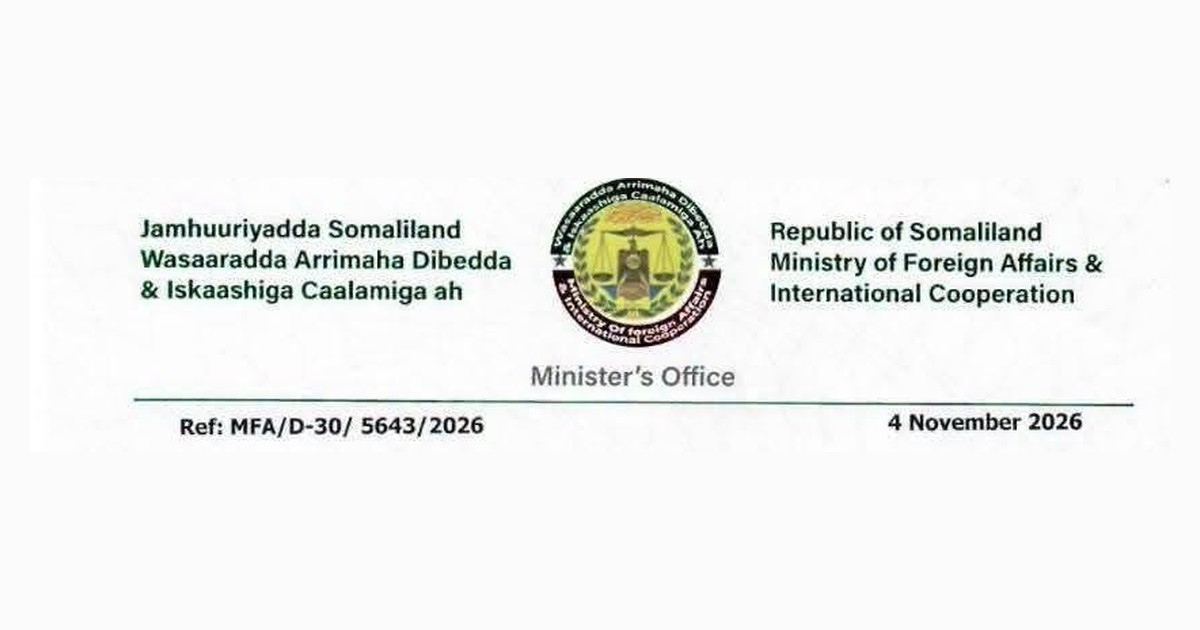
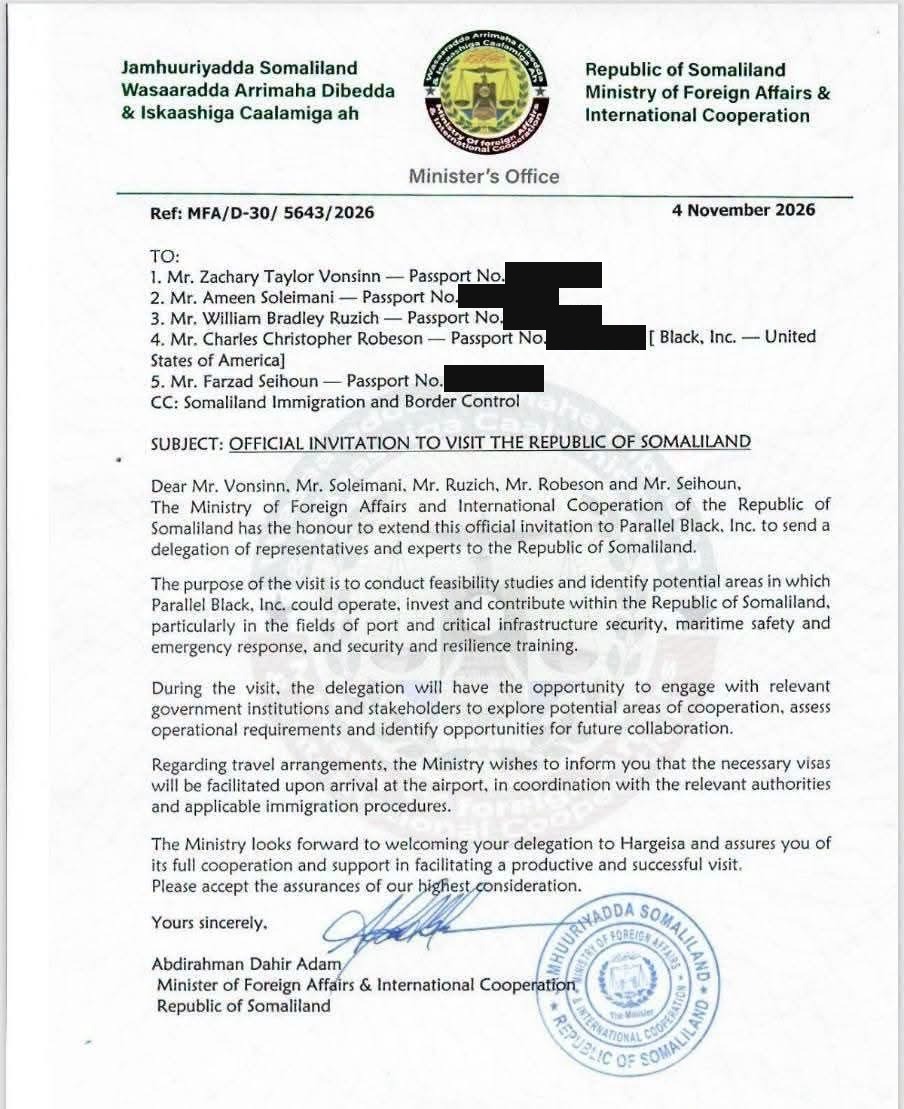
On 4 November 2026, Somaliland’s Minister of Foreign Affairs and International Cooperation, Abdirahman Dahir Adam, issued an official invitation to five representatives of Parallel Black, Inc., a United States company.
The ministerial letter, bearing an official reference number, government seal and ministerial signature, invited the delegation to Somaliland to undertake feasibility studies and explore potential investment and cooperation opportunities.
The proposed areas of engagement included port and critical infrastructure security, maritime safety and emergency response, security and resilience training, and potential investment and commercial cooperation.
The Ministry further assured the delegation that the necessary visas would be facilitated upon arrival and that the government would provide cooperation and support throughout the visit.
 Ouvrir l’image en grand dans un nouvel onglet.
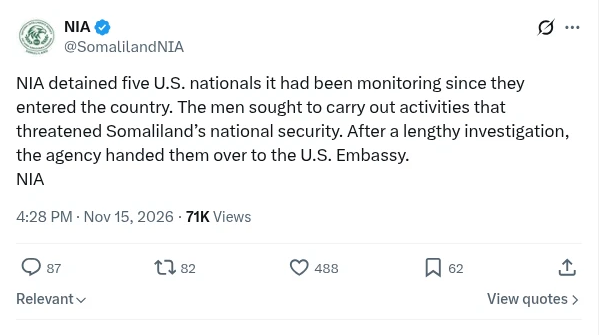
However, on 15 November 2026, Somaliland’s National Intelligence Agency (NIA) announced that it had detained the five American nationals following what it described as a lengthy investigation into activities allegedly threatening Somaliland’s national security.
The agency did not publicly explain the specific activities that allegedly constituted a national security threat.
 Ouvrir l’image en grand dans un nouvel onglet.
This sequence of events raises fundamental questions about the government’s internal coordination and the responsibility of its leadership.
How does a Foreign Ministry formally invite foreign nationals, issue diplomatic assurances and facilitate their entry, while the country’s intelligence agency subsequently detains those same visitors on national security grounds?
Were the relevant security institutions consulted before the invitation was issued? Were appropriate clearances obtained? If concerns existed before their arrival, why were they not addressed through established governmental and diplomatic channels?
These questions expose an apparent failure of institutional coordination that requires a clear explanation from the President and his administration.
2. THE EXPOSURE OF PASSPORT INFORMATION: A SERIOUS PRIVACY AND CONFIDENTIALITY CONCERN
Even more disturbing is the public circulation of a copy of the official ministerial invitation containing the five individuals’ names and passport numbers.
Passport numbers are sensitive personal identifiers. Their disclosure creates potential risks of identity fraud, impersonation, targeted harassment and other forms of personal and security-related exploitation.
The fact that the information appeared in an official government document does not make it public information.
Documents containing passport details, identification records and confidential information supplied for diplomatic, immigration or administrative purposes must be handled responsibly and protected against unauthorised disclosure.
There is a fundamental distinction between a government institution lawfully collecting personal information for legitimate official purposes and that information subsequently becoming publicly accessible.
Even when intelligence agencies have legitimate national security concerns, the collection, retention, processing and disclosure of personal information must remain subject to principles of legality, necessity, proportionality and accountability.
National security does not automatically justify the publication of passport numbers. Intelligence investigations do not eliminate the obligation to protect personal confidentiality.
SHRMG is particularly concerned that the public circulation of this document may have exposed the individuals to risks that could have been entirely avoided.
The authorities must establish who released the document, whether its disclosure was authorised, how it entered the public domain and what measures have been taken to protect the affected individuals.
3. THE LEGAL OBLIGATION TO RESPECT PRIVACY AND PERSONAL DATA CONFIDENTIALITY
SHRMG emphasises that Somaliland’s institutions, in exercising governmental authority, have responsibilities to uphold fundamental human rights and internationally recognised standards of privacy and personal-data protection.
These responsibilities are not optional administrative practices. They are essential elements of lawful and accountable government.
Several important legal instruments and principles are directly relevant to this incident.
A. Somaliland Constitution — Article 24(3): Protection of Private Life
Article 24(3) of the Somaliland Constitution expressly provides:
“Every person shall have the right to have his dignity, reputation and private life respected.”
This provision is particularly significant because it protects every person, not merely Somaliland citizens.
The five American nationals were therefore entitled to have their dignity and private lives respected while engaging with Somaliland’s governmental institutions.
The public exposure of their passport information raises serious questions about whether this constitutional protection was respected.
B. Somaliland Constitution — Articles 25 and 27: Protection Against Unlawful Detention
Article 25 establishes that no person shall be deprived of liberty except in accordance with the law.
Article 27 provides safeguards for individuals deprived of their liberty, including access to legal representation and the requirement that persons detained over alleged criminal offences be brought before a court within 48 hours.
The authorities must clarify the legal basis of the detention and demonstrate that the applicable constitutional safeguards were observed.
C. Universal Declaration of Human Rights — Article 12: Protection of Privacy
Article 12 of the Universal Declaration of Human Rights states:
“No one shall be subjected to arbitrary interference with his privacy, family, home or correspondence, nor to attacks upon his honour and reputation.”
It further establishes everyone’s entitlement to legal protection against such interference or attacks.
The Universal Declaration was adopted as a common international standard for all peoples and nations. Its protections are not dependent upon an individual’s nationality or the international recognition status of the territory in which they find themselves.
D. International Covenant on Civil and Political Rights — Article 17
Article 17 of the ICCPR establishes the internationally recognised protection against arbitrary or unlawful interference with privacy and unlawful attacks upon honour and reputation.
It also recognises the right to legal protection against such interference.
SHRMG invokes this provision as an important international human rights standard. Its direct treaty applicability to Somaliland is a separate legal question and should not be confused with the importance of the underlying protection.
E. International Personal-Data Protection Principles
International data-protection standards establish that personal information should be:
- Collected and processed lawfully and for legitimate purposes.
- Protected against unauthorised access and disclosure.
- Handled securely and confidentially.
- Disclosed only where there is a lawful and justified basis.
- Retained and used in accordance with the purpose for which it was collected.
These principles are particularly important when government institutions handle passports, immigration records, diplomatic correspondence and intelligence-related personal information.
The possession of sensitive personal information by a public authority does not give officials unrestricted permission to publish or circulate it.
The authorities must therefore explain what confidentiality safeguards governed the ministerial invitation, who had access to the document and whether any applicable domestic rules or official confidentiality obligations were breached.
4. PARALLEL GOVERNMENTS AND THE FAILURE OF PRESIDENTIAL OVERSIGHT
Beyond the immediate privacy concerns, this incident exposes a potentially deeper institutional problem within President Cirro’s administration.
The Ministry of Foreign Affairs appears to have operated on one understanding of the delegation’s visit, while the National Intelligence Agency subsequently acted on another.
One institution issued an official invitation, promised cooperation and facilitated a diplomatic engagement. Another institution monitored, investigated and detained the invited visitors.
This raises the troubling impression of competing centres of authority operating within the same administration.
A government cannot maintain credible diplomatic relations when its institutions appear incapable of coordinating their decisions and responsibilities.
The Foreign Ministry cannot make official commitments to foreign visitors without appropriate institutional coordination. Equally, intelligence agencies must operate within clearly defined legal authority and remain accountable for their actions.
President Cirro cannot simply allow these institutions to operate independently of one another without explaining who is responsible for the resulting contradictions.
The President bears ultimate political responsibility for ensuring that the institutions under his administration operate coherently, lawfully and in accordance with established governmental procedures.
The issue is therefore not simply an intelligence operation or an administrative misunderstanding. It is a question of institutional governance, presidential oversight and the credibility of Somaliland’s public administration.
5. THE POTENTIAL SECURITY CONSEQUENCES AND DAMAGE TO INTERNATIONAL CONFIDENCE
The public exposure of passport information is not a harmless administrative mistake.
Passport details can be exploited for identity fraud, impersonation and targeted activities. Their publication can also expose individuals to unwanted attention, harassment and other security risks.
The circumstances are particularly concerning because the individuals had already been publicly associated with an intelligence investigation and allegations involving national security.
The authorities should have recognised that further exposing their identities and personal identification information could create unnecessary additional risks.
The fact that the individuals are American nationals makes the matter particularly sensitive from a diplomatic and international perspective.
Foreign businesses, investors and international partners must have confidence that official government invitations, commercial discussions and personal documentation will be handled securely.
If foreign nationals invited through official ministerial channels can subsequently be detained without a publicly explained institutional process, while their sensitive personal information circulates online, the confidence of potential international partners may be undermined.
Somaliland’s credibility as a destination for international investment and cooperation depends not only on its security institutions but also on the professionalism, reliability and accountability of its entire administration.
6. SHRMG’S DEMANDS
In light of these concerns, the Somaliland Human Rights Monitoring Group calls upon President Abdirahman Mohamed Abdillahi’s administration and the relevant public institutions to:
- Commission an independent investigation into the circumstances surrounding the official invitation, subsequent detention and public disclosure of the five American nationals’ personal information.
- Identify the source of the document disclosure and establish whether the ministerial invitation was released by an authorised government official or through an unauthorised channel.
- Establish accountability for any unlawful disclosure of personal information and take appropriate administrative or legal action against officials found responsible.
- Remove exposed passport information from government-controlled platforms and request its removal from other channels where legally and practically possible.
- Explain the apparent contradiction between the Foreign Ministry and the National Intelligence Agency, including whether appropriate security clearances and inter-agency consultations took place before the invitation was issued.
- Clarify the legal basis of the detention and provide assurances that the constitutional rights and procedural safeguards of the individuals were respected.
- Establish and enforce clear confidentiality protocols governing the handling of passports, immigration records, diplomatic correspondence and other sensitive personal information across all public institutions.
- Guarantee that foreign visitors and investors receive appropriate legal protection, including protection against arbitrary treatment, unlawful interference with privacy and unnecessary exposure of personal information.
- Provide appropriate assurances to the affected individuals and the United States authorities that the circumstances surrounding the disclosure are being investigated and that reasonable measures are being taken to prevent further exposure or misuse of their personal information.
CONCLUSION: STATE RESPONSIBILITY MUST BE MATCHED BY INSTITUTIONAL ACCOUNTABILITY
SHRMG reiterates that national security is a legitimate and important responsibility of every government. However, the protection of national security must operate within the boundaries of law, constitutional guarantees and fundamental human rights.
The exercise of governmental authority brings corresponding responsibilities. Public institutions must protect personal information, respect confidentiality, safeguard the rights of individuals and ensure that intelligence operations are conducted within lawful and accountable frameworks.
The five American nationals were officially invited by Somaliland’s Foreign Minister to explore potential investment opportunities. Their subsequent detention by the intelligence agency, followed by the public circulation of an official document containing their passport information, raises questions that the administration cannot reasonably ignore.
President Cirro must explain how this situation occurred, which institutions were responsible and what measures will be taken to prevent a recurrence.
Somaliland’s international credibility cannot be built solely through diplomatic engagements, investment invitations and appeals for international recognition. It must also be demonstrated through the conduct of its institutions, the protection of individual rights and respect for the rule of law.
A government that invites foreign nationals into its territory assumes a responsibility to treat them lawfully, protect their personal information and ensure their security.
National security cannot justify institutional disorder. Intelligence authority cannot override constitutional protections. And official government confidentiality cannot become disposable whenever politically or administratively convenient.
SHRMG therefore calls for transparency, an independent investigation and accountability for any violations established.
State responsibility demands more than the exercise of authority. It demands respect for the rights and dignity of every individual.
SOMALILAND HUMAN RIGHTS MONITORING GROUP (SHRMG)
Promoting human rights, accountability, the rule of law and institutional responsibility.